Edouard Manet by Forty Sandra
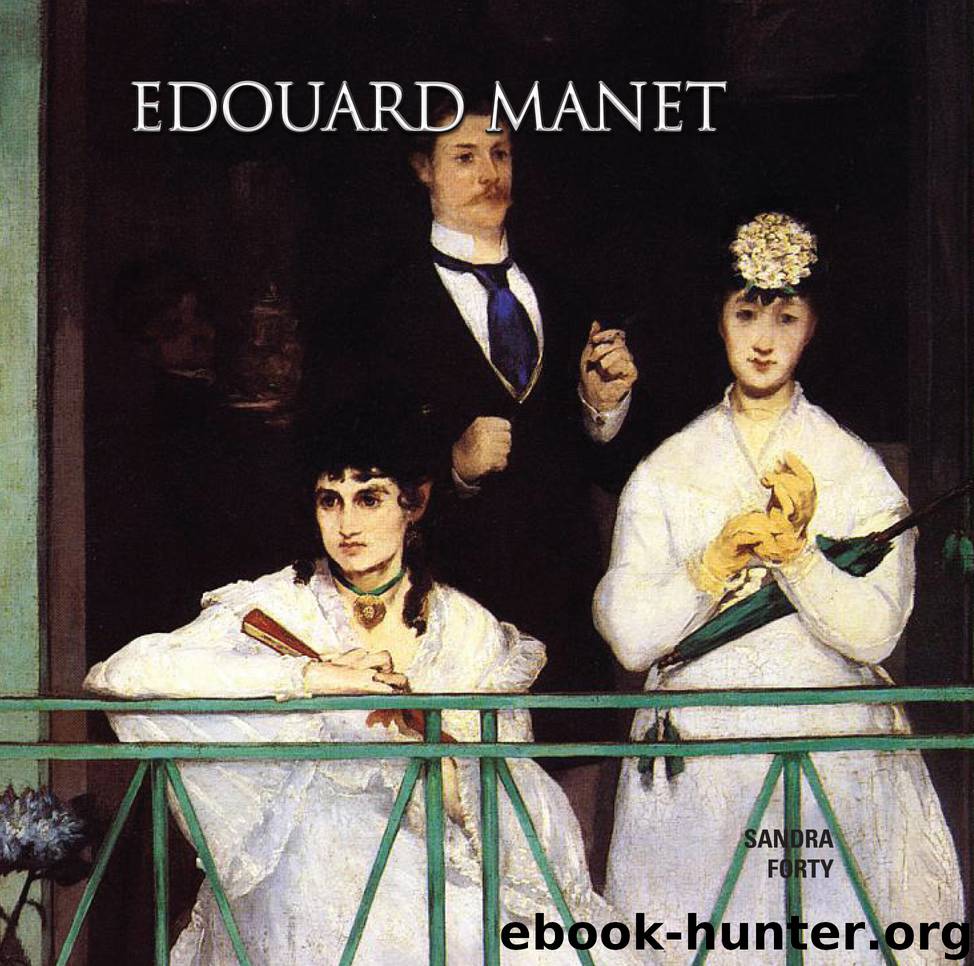
Author:Forty, Sandra [FORTY, SANDRA]
Language: eng
Format: epub
ISBN: 9781844062881
Publisher: TAJ Books International
A Study for “A Bar at the Folies-Bergeres” painted in 1881. A Bar at the Folies-Bergeres is probably one of Manet’s most recognizable paintings.
In July 1870 the Franco-Prussian War broke out and, following the establishment of the unstable Third Republic, Manet closed his studio and stored his paintings with the art collector Théodore Duret. It was a very good decision because his studio was destroyed during the conflict. He remained in Paris but sent his family away to safety in the Pyrenees. In November 1870 he joined the Garde Nationale. But within three months he joined his family in Arçachon. After the Communards’ revolution in May he returned to Paris where life slowly returned to normal.
The new meeting place for the avant-garde was Nouvelle Athènes on Place Pigalle. After the destruction of his old studie, Manet was forced to find a new one and in July 1872 moved to 4 rue de Saint-Pétersbourg.
In 1874 Manet was invited to exhibit at the first Impressionist exhibition, but he refused. Despite his love for modernism and the abuse he had endured because of it at the hands of the Salon, he was still an ardent supporter of the Salon and wanted and needed such establishment approval for his work. Even so, the Salon refused to hang two of his paintings that season (The Swallows and Masked Ball at the Opera), but accepted a third work, The Railway.
Manet decided to open his studio to the public so they could see for themselves the rejected paintings, as well as The Artist and The Laundress and other works. Over 4,000 people came to see his private exhibition. The following year the Salon relented and accepted Faure as Hamlet, but rejected Nana, an informal portrait of a young prostitute in her underclothes standing beside an obviously wealthy client. The model was a well-known grande coquette, Henriette Hauser, the Parisian mistress of the Prince of Orange. Determined to show the painting to the public, Manet managed to hang Nana in the window of Giroux’s luxury boutique on the Boulevard des Capucines where it almost caused a riot.
Manet declined to offer any paintings to the Salon the following year. This may have been pride but also expediency as his health was beginning to trouble him; he didn’t even hold his own private exhibition.
In 1878 the Manet family moved to 39 rue de Saint-Petersburg and the following year Manet took what proved to be his last studio at 77 rue d’Amsterdam. By the fall his left leg was giving him trouble and he took treatment at Bellevue, but his leg became worse and his general health suffered. In 1880 a rapprochement of sorts was reached with the Salon when it accepted his work and awarded him a second place medal for M. Pertuiset, the Lion-Hunter, which gave Manet hors concours status meaning that he could exhibit unchallenged from then on. Ironically, it was by no means one of his better paintings, being almost primitive in style and execution. Nevertheless he
Download
This site does not store any files on its server. We only index and link to content provided by other sites. Please contact the content providers to delete copyright contents if any and email us, we'll remove relevant links or contents immediately.
The Great Music City by Andrea Baker(33427)
Aircraft Design of WWII: A Sketchbook by Lockheed Aircraft Corporation(32380)
Call Me by Your Name by André Aciman(20703)
The Secret History by Donna Tartt(19442)
The Art of Boudoir Photography: How to Create Stunning Photographs of Women by Christa Meola(18753)
Shoot Sexy by Ryan Armbrust(17843)
Plagued by Fire by Paul Hendrickson(17527)
Portrait Mastery in Black & White: Learn the Signature Style of a Legendary Photographer by Tim Kelly(17098)
Adobe Camera Raw For Digital Photographers Only by Rob Sheppard(17076)
Photographically Speaking: A Deeper Look at Creating Stronger Images (Eva Spring's Library) by David duChemin(16794)
Ready Player One by Cline Ernest(15122)
Pimp by Iceberg Slim(14777)
Bombshells: Glamour Girls of a Lifetime by Sullivan Steve(14210)
The Goal (Off-Campus #4) by Elle Kennedy(13949)
Art Nude Photography Explained: How to Photograph and Understand Great Art Nude Images by Simon Walden(13142)
Kathy Andrews Collection by Kathy Andrews(12077)
The Priory of the Orange Tree by Samantha Shannon(9351)
The remains of the day by Kazuo Ishiguro(9202)
Thirteen Reasons Why by Jay Asher(9104)
